EV charging software is not a side project — Pulse
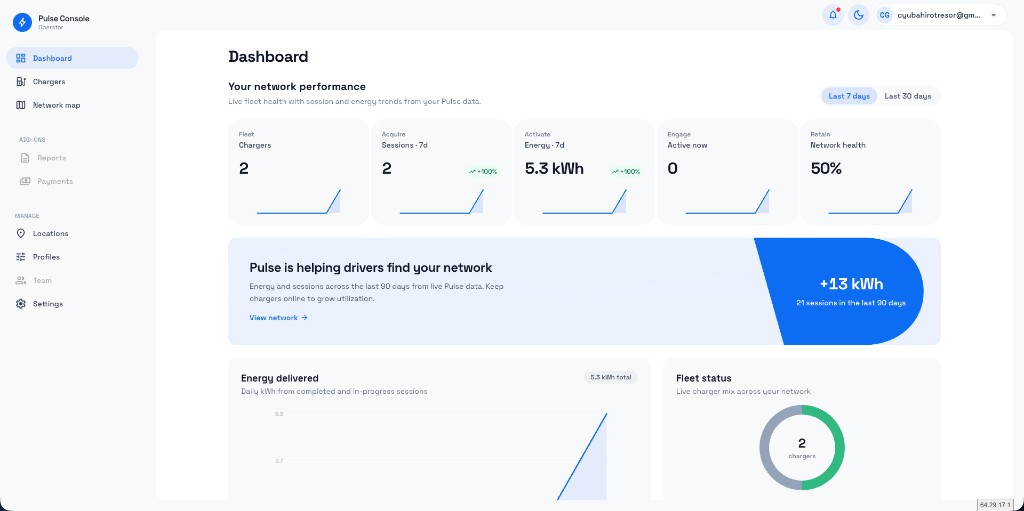
For a CPO or an EV-focused company with a capable technology team, building a charging platform in-house can sound like the obvious move.
You know your chargers. You understand your customers. Your team can build software.
But a charging business is not just a hardware and energy operation — and charging software is not simply a map, dashboard, or payment screen.
It is the system that connects drivers, chargers, payments, operations, support teams, partners, fleets, and the wider EV ecosystem.
That system needs to work every day.
Building is only the beginning
A first version can be built. The harder work starts afterwards.
Your team must maintain charger integrations, process live status, handle driver support, monitor failed sessions, manage access and payments, secure data, build reporting, maintain APIs, and keep the system compatible with changing standards and partner requirements.
Then there is the question every growing network faces: how do drivers discover your chargers outside your own app?
A proprietary platform can become a closed system just as the market needs more connection, more trust, and more interoperability.
Why using a competitor's platform is not a long-term strategy
Some CPOs may consider using another operator's system because it is already available. It may appear faster than building from scratch.
But it creates a difficult strategic question: should your charging network depend on the software, roadmap, commercial terms, and data environment of a competing network?
Your company needs control over its brand, customer experience, operational data, and growth strategy. A platform operated by a rival CPO may create real concerns around:
- Competitive independence: A competitor's priorities may not match your own.
- Data governance: Your network, customer, usage, and commercial data should be governed through clear, independent agreements.
- Brand ownership: Your drivers should experience your network as your business — not as an extension of another operator.
- Interoperability: A closed or competitor-led system can make it harder to work openly with fleets, roaming partners, property owners, and future integrations.
- Compliance responsibility: Even when software is provided by someone else, the operator remains responsible for operating its network appropriately.
Rwanda's charging-infrastructure regulations are explicitly concerned with safety, reliability, efficiency, interoperability, and environmental sustainability. Software choices should support those outcomes, not create unnecessary dependency or uncertainty. Read the RURA regulations.
This is not to say that using another CPO's system is automatically non-compliant. It is not. But before taking that route, operators should carefully assess contractual control, data handling, interoperability, and regulatory obligations with appropriate legal and technical advice.
The value of a neutral third party
Pulse gives operators a different route.
Pulse is not another CPO competing for your drivers, charging revenue, or network position. It is neutral EV infrastructure software built to help operators, fleets, and partners work better together.
With Pulse, a CPO can gain:
- Discovery on a driver-facing charging map
- Network and station visibility
- Live operational status
- APIs and integration support
- OCPP- and OCPI-aligned capabilities
- Smart charging and operational tools
- Fleet and enterprise options
- A path from a simple public listing to a scalable digital platform
Most importantly, Pulse can work alongside your existing charger management, billing, or operational systems. You do not have to replace everything to improve the driver and operator experience.
Keep your focus on your network
Your competitive advantage should be the network you build: the locations you secure, the service you provide, the reliability you deliver, and the partnerships you create.
Pulse handles the digital infrastructure that makes those strengths visible, connected, and scalable.
Do not spend years building a closed platform from scratch. Do not build your future on a competitor's platform.
Build your charging business on independent, interoperable infrastructure.
Pulse gives your network the software foundation to compete — and the neutrality to grow.
Explore Pulse for Business or contact business@pulsemap.app.